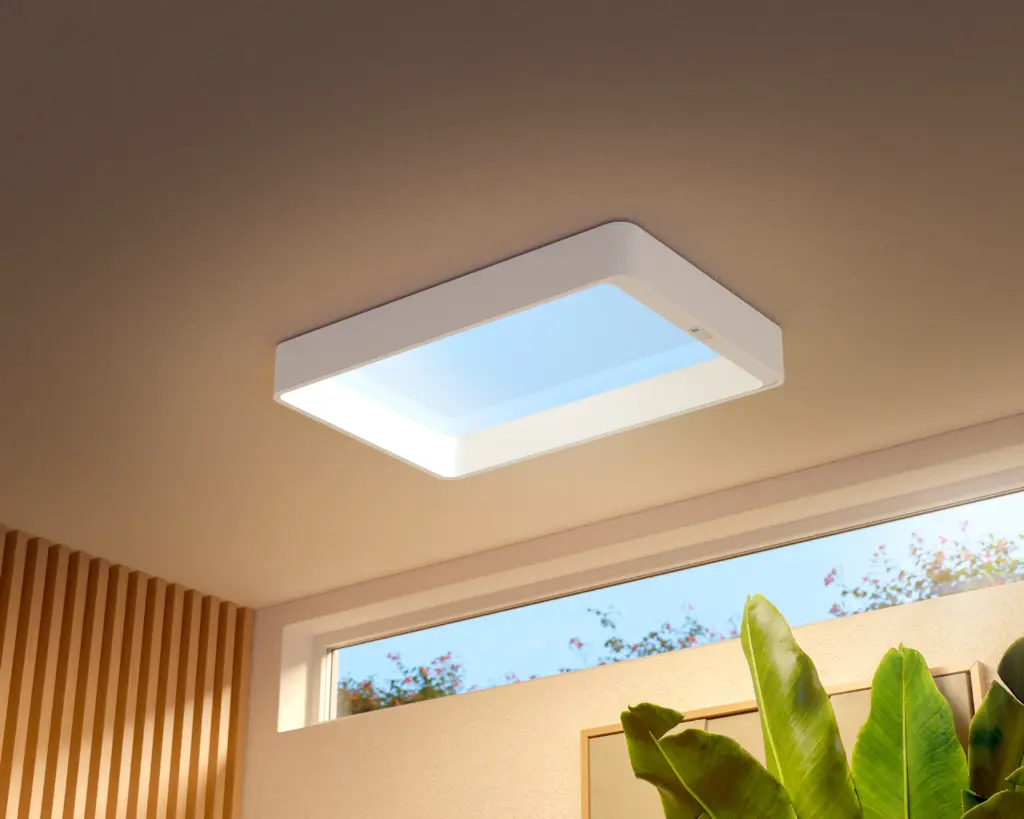

Lighting company Signify is expanding its portfolio with a large-format LED ceiling panel designed to simulate the natural progression of daylight. Available from around 500 euros, the “Philips Skylight” is aimed specifically at windowless rooms, yet at launch it lacks one important smart home interface.
With the Philips Skylight, Signify aims to solve a problem that occurs particularly in older buildings, basements or interior bathrooms: the lack of natural daylight. The large-format LED panel is visually modeled on a classic skylight. By dynamically adjusting brightness and color temperature over the course of the day, it is meant to create the illusion of a real roof window, boosting well-being in dark rooms.
A dynamic lighting concept with an optical trick
At the heart of the Skylight is control based on the principle of “Human Centric Lighting” (HCL). While the panel emits a bright, bluish light in the morning and at midday, it gradually shifts toward warmer color ranges as evening approaches.
To reinforce the impression of real sunshine, Signify uses an optical design element: only two of the panel’s four sides are actively lit. This causes the light to fall into the room in a directional way and cast realistic shadows – just as if the sun were shining through a real window at a particular angle. Even so, the light output is said to be sufficient to adequately illuminate larger rooms as well.
The device is offered in two sizes and carries an IP44 certification, meaning it is dust-protected and resistant to splashing water. This makes the panel suitable for use in damp rooms such as bathrooms.
Special “VitaUp” variant with UV-B radiation
In addition to the standard version, the manufacturer offers the “Skylight VitaUp” variant. It features an integrated UV-B module intended to stimulate the body’s own vitamin D synthesis. Since an overdose of UV radiation can be harmful to health, a safety function is built in: the UV-B light switches off automatically after a maximum of eight hours of operation. Whether this function offers a measurable health benefit in everyday life depends heavily on individual usage habits and how much time a person spends outdoors.
The big disappointment for smart home enthusiasts
Despite the “Philips” brand name and its affiliation with Signify, the product has a significant gap: at present there is no integration into the widely used Philips Hue ecosystem. Control of the five predefined lighting scenes and the daylight progression is handled exclusively via a remote control included in the delivery. For smart home users who want to control their lighting centrally via protocols such as Zigbee or Matter, this considerably limits the device’s appeal.
According to the manufacturer, installation requires fixed ceiling wiring and, due to the size of the panel, is recommended to be carried out by two people.
Pricing and availability
The Philips Skylight sits in the premium segment. With an entry price of 499.99 euros, the product is aimed primarily at buyers who want to specifically upgrade windowless rooms and are looking for an alternative to conventional, often sterile-looking LED panels.
Background: technical terms explained briefly
- Human Centric Lighting (HCL): A lighting concept that supports the visual and, in particular, the biological rhythm of the human body. By adapting light color and intensity to the natural course of the sun, the sleep-wake rhythm is positively influenced.
- IP44 (protection rating): This classification indicates that an electrical device is protected against the ingress of solid foreign objects (from 1 mm in diameter) and against splashing water from all sides. Ideal for bathrooms.
- UV-B radiation: A portion of the invisible ultraviolet sunlight. On the skin it stimulates the production of vitamin D, but with prolonged exposure it can also cause sunburn.