
US networking giant Ubiquiti is pushing hard into the lucrative market for professional audio and video installations. With the launch of the UniFi Enterprise Audio/Video Bridge (UAV Bridge) and a dedicated switch infrastructure, the company is taking on established AV-over-IP heavyweights. The promise: a seamless, software-defined media network that makes complex specialized hardware obsolete and brings broadcast technology within reach of IT administrators.
In professional event, conference, and broadcast technology, a strict divide has long existed: on one side the classic IT infrastructure for data streams, on the other highly specialized, proprietary AV systems. Whenever video and audio had to be transmitted over IP networks with zero latency and in perfect sync, it usually meant astronomical hardware costs and an immense configuration effort.
With the introduction of the UniFi Enterprise Audio/Video (EAV) series – led by the versatile EAV Bridge – Ubiquiti is tearing down these walls. The system turns the distribution of 4K video and professional audio into a pure network application that is fully integrated into the familiar UniFi ecosystem.
A Chameleon for the Media Backbone: The EAV Bridge
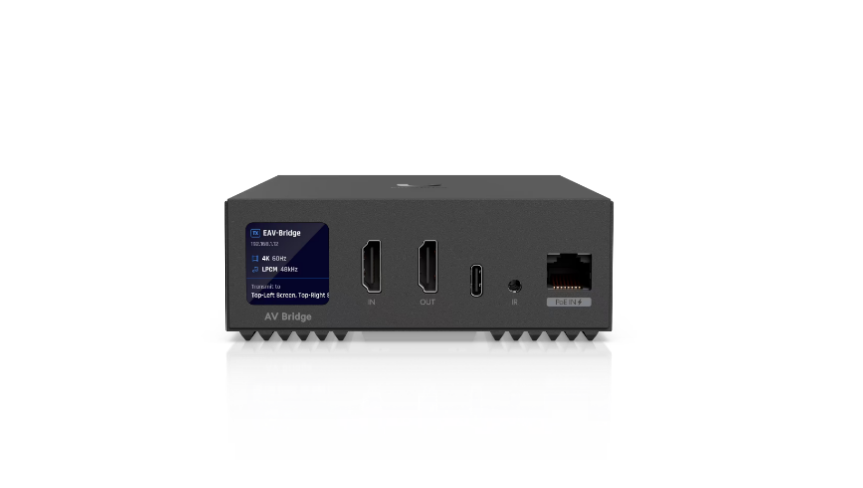
The heart of this strategy is the UniFi EAV Bridge. Measuring just 109 x 134.4 x 40.4 mm and housed in a rugged aluminum enclosure, the device is built for the tough day-to-day life in server rooms, truss rigs, or behind display walls. Thanks to its flexible mounting options, it can be attached to DIN rails, walls, or poles (38 to 50 mm in diameter).
The real trick, however, lies in the flexibility of the hardware: A single device (single SKU) acts either as an encoder (sender/source) or as a decoder (receiver/destination). This software-side convertibility drastically reduces the inventory system integrators need to stock.
+-----------------------------------------------------------------+
|                      UniFi EAV-Bridge                           |
|  [GbE RJ45 PoE+ In] ---- (Etherlighting™) ---- [USB-C 5V/1A]   |
+-----------------------------------------------------------------+
|  AUDIO INPUT:                          AUDIO OUTPUT:            |
|  - (1) HDMI In                         - (1) HDMI Out           |
|  - (2) XLR Female Combo (48V Phantom)  - (2) XLR Male Analog    |
+-----------------------------------------------------------------+
|  VIDEO INPUT:                          VIDEO OUTPUT:            |
|  - (1) HDMI 2.0 (4K60 RGB/YCbCr)        - (1) HDMI 2.0 (4K60)    |
+-----------------------------------------------------------------+
|  CONTROL & DISPLAY:                                             |
|  - 1.3" LCM Touchscreen  - 3.5 mm IR (In/Out)                   |
+-----------------------------------------------------------------+
The key technical specifications at a glance:
- Video performance: Full HDMI 2.0 support for 4K UHD at 60 frames per second. This includes demanding color spaces and sampling formats such as RGB (High/Low) as well as YCbCr in the 4:4:4, 4:2:2, and 4:2:0 configurations.
- Audio interfaces: Alongside digital HDMI audio, the bridge features two analog XLR combo jacks (6.35 mm) as inputs – including switchable 48V phantom power for condenser microphones. On the output side, two analog XLR male jacks are available. The frequency response is specified at studio level, from 20 Hz to 20 kHz ($\pm0.5\,\text{dB}$).
- Power & network: The device needs just a single Cat cable. Power is supplied via 802.3at PoE+ at a maximum power draw of 14 watts. The network port is also equipped with Ubiquiti’s Etherlighting™, which makes it easier to visually identify ports and VLANs in the rack.
The Physical Bridge: XLR-to-RCA Balancing
For integrating consumer audio devices (such as media players or hi-fi amplifiers), Ubiquiti documents a precise pin assignment to prevent ground loops and signal loss when connecting balanced XLR ports to unbalanced RCA (Cinch) connectors:
- Signal path: XLR pin 2 (hot) is connected directly to the inner center pin of the RCA plug.
- Ground/shielding: XLR pin 1 (ground) and XLR pin 3 (cold) must be bridged together and routed to the outer RCA sleeve.
Synchronization in the Sub-Microsecond Range
The biggest challenge with AV-over-IP is timing offset (jitter). If the video signal runs ahead of the audio, or if speakers in a large hall are not playing in perfect phase, the media experience collapses.
Ubiquiti solves this problem through the strict implementation of the Precision Time Protocol (PTP) per IEEE 1588. The EAV system provides a network-wide, high-precision reference clock. The hardware supports all the relevant PTP modes:
- Grandmaster Clock: The leading timekeeper in the network.
- Boundary Clock: Filters the time and passes it on to sub-segments in order to offload the master.
- Transparent Clock: Measures the packets’ transit delay through the switch and corrects it in real time.
The result is a synchronization accuracy in the sub-microsecond range. Even in complex, cascaded network topologies, media transport remains absolutely deterministic and jitter-free to the human eye or ear.
The Industry Alliance: Dante, AES67, and SDVoE
Ubiquiti doesn’t even try to reinvent the wheel when it comes to media protocols, instead relying consistently on established industry standards. The system slots seamlessly into professional broadcast and studio environments:
- Audio compatibility: Native support for Dante and AES67. This lets the EAV Bridge exchange audio signals directly with mixing consoles, amplifiers, and microphone arrays from leading manufacturers. SMPTE ST 2110 workflows are supported as well.
- Video infrastructure: The system is SDVoE-capable (Software Defined Video over Ethernet). This enables the near-latency-free transmission of uncompressed 4K video over standard Ethernet infrastructures.
For smooth operation, the system strictly requires a 1 GbE network connection as well as the activation of jumbo frames to minimize overhead in the massive data streams. Beyond simple one-to-one transmissions, complex one-to-many multicast streams are possible, as is the build-out of massive video walls of up to 8×8 panels (64 displays in total).
A Deep Dive for IT Admins: UniFi Network 10.3
The real declaration of war on traditional AV systems is the software integration. Control is handled not through obscure third-party tools, but directly in the familiar UniFi Network Application (from version 10.3 onward).
Together with its specialized hardware siblings – the Enterprise Audio/Video XG 24 PoE and the Enterprise Audio/Video Fiber Switches – the software unfolds powerful diagnostic tools:
- Latency visualization: Administrators can visually track the exact signal propagation time across the entire network.
- Time Machine: This feature makes it possible to retroactively analyze the port status and historical performance of the media network in order to isolate sporadically occurring faults down to the second.
- Multicast analyzer (future outlook): A more in-depth IGMP analysis tool has been announced for upcoming updates, designed to automatically optimize multicast streams and prevent a “flooding” of the rest of the data network.
On top of that, the entire system is NDAA-compliant (National Defense Authorization Act), which enables its use in security-critical US government projects and agencies.
Conclusion and Outlook
With the UniFi EAV series and the versatile EAV Bridge, Ubiquiti is standardizing professional media technology. By uniting HDMI, XLR, Dante, and 4K streaming in a compact, PoE+-powered enclosure and handing full control to its in-house network software, the company is democratizing a previously elite discipline.
Established AV manufacturers had better brace themselves: if the IT department can simply “configure” media technology on the side in the future, without expensive specialists having to be called in, the UniFi EAV ecosystem is likely to rapidly capture market share in the enterprise space, in educational institutions, and in conference centers.