
At its developer conference in Zhuhai, China, tech company Oppo officially unveiled its new user interface, ColorOS 17. Based on Android 17, the system aims to significantly reduce resource usage through deep technical optimizations, enhance background stability, and bring new artificial intelligence features to smartphones.
More Efficient Engines for Memory and Graphics
At the core of the technical overhaul are specialized system engines. The so-called Polar Light Engine (also referred to as the Aurora Engine) is designed to improve system efficiency: According to Oppo’s internal benchmarks, RAM consumption when launching and running applications drops by 25 percent. At the same time, the graphics rendering load decreases by 30 percent.
To manage background tasks, Oppo relies on the Tidal Engine and an accompanying Memory Engine. According to the manufacturer, app retention and stability in the background improve by an average of 55.6 percent. For third-party apps, Oppo also promises 50 percent faster scrolling and loading, while app switching is said to be accelerated by 15 percent. With these optimizations, the company promises sustained, smooth system performance for up to six years of use.
On-Device AI and New Fluid Design
Another major focus is integrated AI features executed directly on the device (on-device). The new on-device compute model featuring a linear attention architecture natively supports a 128K context window and, according to Oppo, requires 48 percent less memory and 55 percent less power than its predecessor. This is complemented by proactive assistant features, predictions for typical usage scenarios, and tools such as “AI One-Touch Flash Note,” which allows users to quickly capture package tracking or ticket codes digitally.
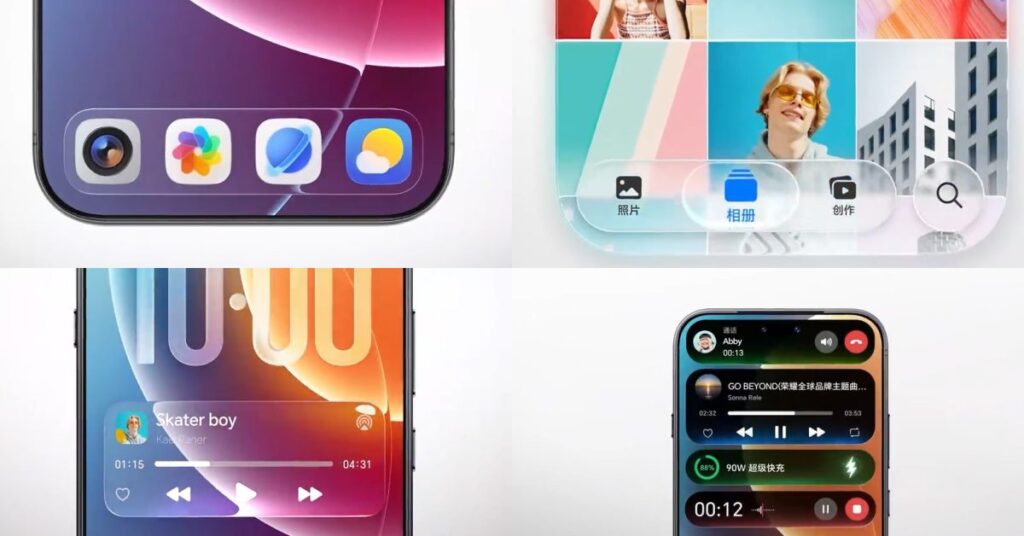
Visually, ColorOS 17 introduces the “Fluid Design” language, characterized by softer lighting effects, revamped animations, and a glass-like aesthetic. There is also a strategic shift across sub-brands: ColorOS 17 will also be rolled out to OnePlus and Realme devices, with the previously independent Realme UI being discontinued.
Rollout Schedule and Availability
The new operating system is slated to roll out gradually to more than 130 models. In China, the stable release rollout begins on October 8, 2026, for newer flagship devices such as the Find X9 series, Find N6, OnePlus 15, and Realme GT8 Pro. The Oppo Find X10 series, launching September 22, 2026, will ship with ColorOS 17 out of the box in the region.
For users outside China, there is currently no official timeline for the update. However, industry observers expect the international rollout to kick off in early 2027.
Sources: Borncity.com