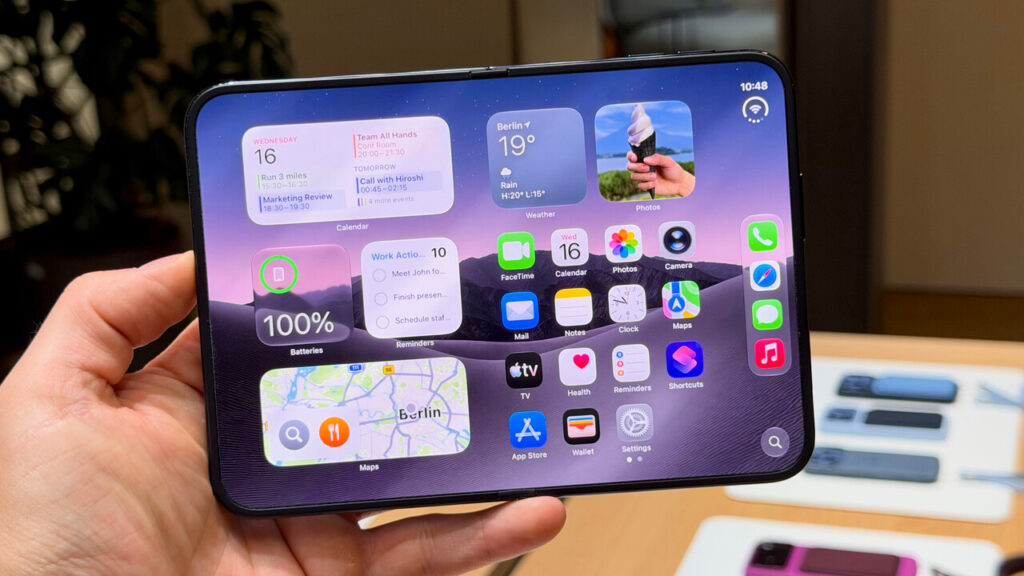

Seven years after Samsung’s first foldable device, Apple is finally entering the foldable segment: Pre-orders for the new iPhone Duo kick off on October 16, 2026, with deliveries starting on October 23. Starting at €2,299 for the 256 GB model, the device marks a new pricing peak in the manufacturer’s portfolio.
Unique Aspect Ratio and Matte Display Finish
Rather than opting for a nearly square unfolded aspect ratio like earlier foldables, Apple uses a ratio close to 1:√2 (1.4:1), inspired by standard DIN paper formats. The outer OLED display measures 5.4 inches at 1,398 × 2,034 pixels, while the unfolded inner display reaches a 7.6-inch diagonal. For comparison, rival Samsung’s Galaxy Z Fold 8 has also shifted away from strictly square inner displays.
On the inner side, Apple relies on a nano-texture surface layer over glass and a supporting titanium plate. This matte finish minimizes reflections and fingerprints while disguising the material-specific crease much more discreetly than glossy surfaces from competitors, although it remains slightly visible depending on the lighting.
Titanium Chassis, Hinge, and the Return of Touch ID
When unfolded, the iPhone Duo measures just 5.2 millimeters, making it the company’s thinnest smartphone to date. Weighing in at 254 grams, the body—crafted from 85 percent recycled titanium and available in “Star White” and “Night Sky”—is comparable to an iPhone 18 Pro Max (249 grams). The stepless hinge enables various standing angles, such as serving as an alarm clock in StandBy mode, in tent mode, or semi-unfolded as a mini laptop with a virtual keyboard.
Face ID was omitted due to spatial constraints: Apple is currently foregoing facial recognition due to technical height limitations, relying instead on Touch ID.
Multitasking on iOS
On the software side, the Duo introduces expanded multitasking features. Users can pin two apps side by side or stacked vertically and save them as permanent app pairs. However, unlike Samsung’s interface, window sizes cannot be adjusted freely. When closed, the app dock moves to the right edge and holds up to four apps, just like in its unfolded state. As initial hands-on impressions from ComputerBase indicate, transitioning between the outer and inner displays is seamless and instantaneous.
Verdict for Prospective Buyers
Technically, Apple delivers a mature first generation with the iPhone Duo, visibly benefiting from years of groundwork laid by its competitors. Beyond the steep price tag, prospective buyers should note that software-based multitasking capabilities remain more rigid than those found on established Android counterparts.
Quellen: Computerbase.de/news