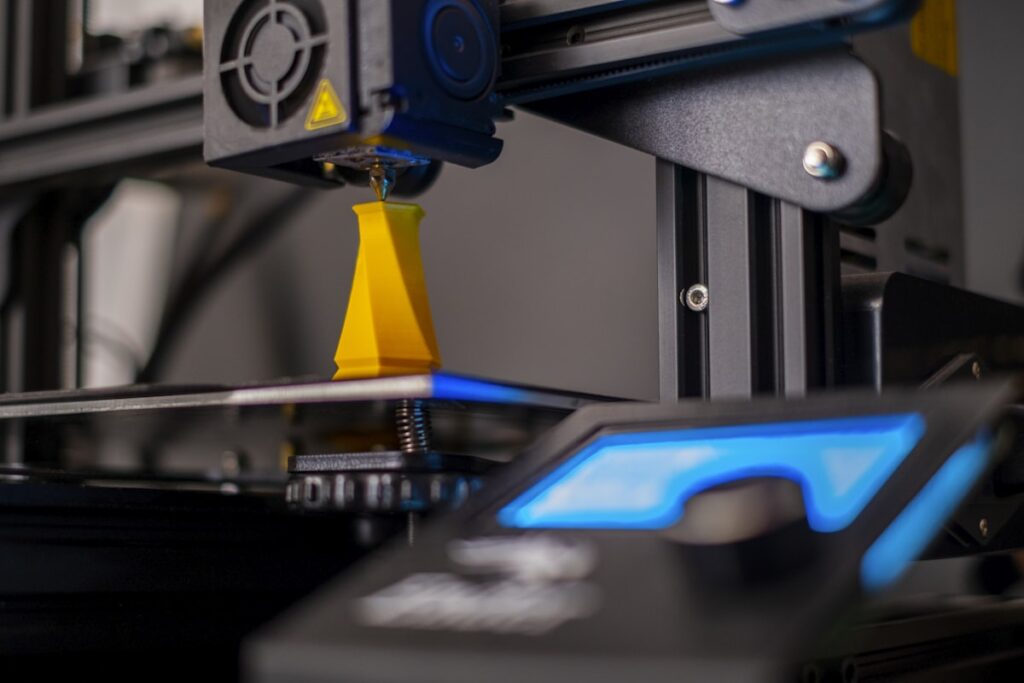

Researchers at Washington State University (WSU) have used artificial intelligence to finally 3D-print GRCop-42, a NASA alloy long considered notoriously difficult to process. Instead of testing millions of possible machine settings by hand, an active-learning model found six working configurations in just 40 experiments over three months – including the first-ever print at a record-low 500 watts of laser power. The work was published on 27 August 2026 in the Proceedings of the AAAI Conference on Artificial Intelligence.
From 37 failures to a working recipe
GRCop-42 is a NASA-developed copper-chromium-niobium alloy that dissipates heat superbly and stays strong under extreme stress – ideal for the combustion chambers of liquid-fuel rocket engines. Those same properties make it hard to handle in powder-based laser printing, where the process spans well over 100 million combinations of laser power, speed and other parameters. The team led by computer science professor Jana Doppa and first author Azza Fadhel started with data from 37 failed attempts and trained a model to estimate the success probability of untested settings.
AI as a shortcut through the parameter jungle
The key is active learning: the algorithm deliberately picks small batches of trials that balance promising regions against uncertain zones, improving with every result. That made 40 real prints enough to uncover six usable recipes. Because many of the winning settings need far less power, the researchers say the alloy could in future be processed on roughly 90 percent of commercial printers – machines that mostly failed with it until now. Doppa calls it a “democratization” of printing this alloy.
What it means – and what is still open
In practice, smaller firms and universities could print aerospace-grade parts without costly specialist equipment. But the approach matters most as a blueprint – the framework can transfer to other alloys and printing methods. A caveat: these are lab-scale results, and whether the configurations hold up as reliably and with the same material quality in series production remains to be shown. The study is no miracle cure, but a strong example of how AI can shortcut the expensive search at the heart of materials research.
Sources: Washington State University (WSU Insider), ScienceDaily, phys.org, Proceedings of the AAAI Conference on Artificial Intelligence (DOI).