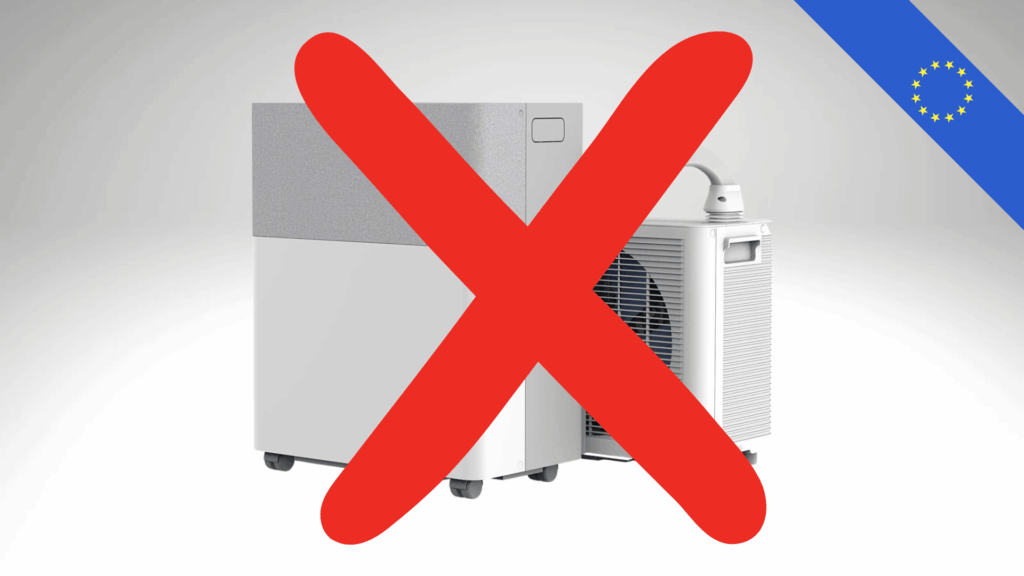

A legal fact-check, regulatory grey zones and the propane-based future of a bestselling model
📣 Update: The Midea PortaSplit is getting an upgrade – the upcoming 2027 generation switches to propane (R290) and should be easier to buy. → Midea PortaSplit gets an upgrade (2027, R290)
Practical tip: End of the cooling season? See our step-by-step guide: Winterizing your Midea PortaSplit.
European climate policy is driving the gradual phase-out of fluorinated greenhouse gases (F-gases) in order to drastically reduce global greenhouse gas emissions. The legal basis for this is Regulation (EU) 2024/573 of the European Parliament and of the Council of 7 February 2024 on fluorinated greenhouse gases, which replaced the previous Regulation (EU) No 517/2014.
A key criterion for approving refrigeration and air-conditioning systems is the Global Warming Potential (GWP). The R32 (difluoromethane) safety refrigerant used in the Midea PortaSplit has a GWP value of 675. Under the tightened limits of the new F-gas regulation, the continued use of this refrigerant in new units is severely restricted in time.
1. The legal framework in detail
A look at the legal text shows that the deadlines are strictly tied to the system architecture of the devices.
Excerpt from Annex IV (placing on the market prohibitions pursuant to Article 11(1)) of Regulation (EU) 2024/573:
- Point 5: “Self-contained air-conditioning and heat pump equipment […] with a rated capacity of up to and including 12 kW, containing fluorinated greenhouse gases with a GWP of 150 or more […] prohibited from 1 January 2027.”
- Point 7: “Air-to-air split systems […] with a rated capacity of up to and including 12 kW, containing fluorinated greenhouse gases with a GWP of 150 or more […] prohibited from 1 January 2029.”
(Source: Official Journal of the European Union, L series, Regulation (EU) 2024/573, Annex IV)
2. The special regulatory status of the Midea PortaSplit: 2027 or 2029?
In practice, classifying the Midea PortaSplit raises complex legal questions. The legislator draws a strict distinction between “self-contained” systems (monoblocks) and “split systems”.
The PortaSplit occupies a technological hybrid position here: it consists of an indoor and an outdoor unit (classic split architecture), yet it is hermetically sealed and mechanically non-separable from the factory. This means the refrigerant circuit remains permanently closed and no intervention by a certified refrigeration technician is required during installation.
- Scenario A (air-to-air split system): If the PortaSplit is assessed purely on its two-part design, the R32 ban does not take effect until 1 January 2029 (Annex IV, Point 7).
- Scenario B (self-contained system): If, on account of its factory-sealed, non-separable lines, it is classified as a portable, self-contained device, the cut-off date moves forward to 1 January 2027 (Annex IV, Point 5).
In Switzerland, the rules are tightened even further by the national Chemical Risk Reduction Ordinance (ChemRRV). Here, a strict import ban on such systems applies to importers and dealers from 1 January 2027, along with a final retail sales ban from 30 June 2027.
3. What does the ban mean for buyers and owners of the PortaSplit?
For consumers who already own a Midea PortaSplit or purchase one before the respective cut-off dates, there is no reason for concern whatsoever. Regulation (EU) 2024/573 governs solely the placing on the market – that is, the initial import and first sale on the European market.
- Unlimited grandfathering: Devices that have already been installed or are already on the market enjoy full grandfathered protection. They may continue to be operated, privately resold and used indefinitely.
- Maintenance and repair: Under Article 13 of the regulation, the use of refrigerants for the maintenance and repair of existing air-conditioning units in this capacity class remains fully permitted. Since the PortaSplit does not, however, come with standard Schrader service valves from the factory, any repair in the event of refrigerant loss (error code EL 0C) remains primarily a technical and economic hurdle rather than a regulatory one.
4. The crux of the successor: the propane challenge (R290)
Propane (R290) is regarded as the future-proof, environmentally friendly alternative to synthetic F-gases. With an extremely low GWP value of 0.02, it is immune to future restrictions under the F-gas regulation. Converting the PortaSplit to R290, however, confronts Midea with an enormous engineering hurdle that lies in the device’s unique architecture.
The safety risk: a highly explosive gas at the window
While the current refrigerant R32 is classified in safety class A2L (mildly flammable), propane belongs to class A3 (highly flammable and explosive).
In the Midea PortaSplit, the heavy rolling-piston compressor sits in the indoor unit. This means the liquid and gaseous refrigerant is continuously pumped through the 2-meter-long hose bundle that runs outdoors through open windows or balcony doors. Here there is a constant risk of mechanical damage – for instance from carelessly pinching it in the window frame, from pets, or from a falling window. If propane escapes indoors as a result of such damage, an ignitable atmosphere can quickly form in the room.
What an R290 successor to the PortaSplit would have to look like
To bring an R290-based successor to market in compliance with the harmonized safety standards (DIN EN 378 and IEC 60335-2-40), Midea would have to completely reinvent the device:
- Strict charge limitation: The propane refrigerant mass in the system would have to be drastically minimized so that, in the event of a leak, the explosion limits in the room are not reached.
- Encapsulated electronics in the indoor unit: Because the compressor – and thus the main refrigerant lines – sit indoors, all switching relays, circuit boards and the control system in the indoor unit must be designed as spark-free components (solid-state relays).
- Sensor-based monitoring: An R290 successor would necessarily have to integrate permanent, highly sensitive leak sensors. If these are triggered, the system must be de-energized immediately and emergency forced ventilation initiated via the fan impellers.
5. Conclusion: Should you still buy the R32 version now?
The coming ban on refrigerants with a GWP seals, in the medium term, the end of the current Midea PortaSplit with R32 charge in the European market.
For end users this means: Anyone toying with the idea of getting the PortaSplit can still do so with complete peace of mind, thanks to the comprehensive legal grandfathering. Waiting for a propane successor model could even prove to be a disadvantage: because of the mandatory explosion-protection and encapsulation measures required for R290, future generations of mobile split air conditioners will become technologically far more complex, structurally heavier, bulkier and presumably noticeably more expensive to purchase.