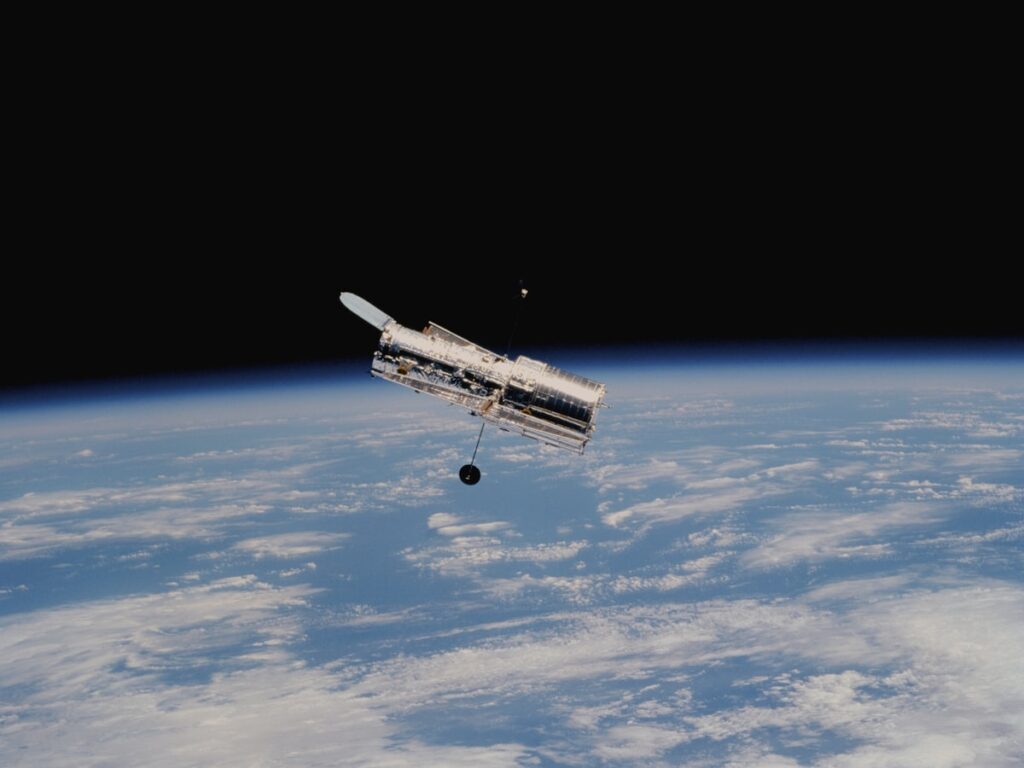

A giant, ten-sided storm pattern is taking shape at Saturn’s south pole. A team led by Agustin Sanchez-Lavega of the University of the Basque Country tracked the so-called decagon with the Hubble Space Telescope. The results were published on 2 September 2026 in the journal Science Advances.
A new counterpart to the famous hexagon
Saturn’s north pole has long carried a striking hexagon formed by a channeled jet stream. At the south pole, researchers have now found a comparable but ten-sided feature for the first time. Unlike the hexagon, which has stayed stable for more than 40 years, the decagon appears young: it emerges in Hubble imagery from 2023 and grows clearer in the 2024 and 2025 observations.
The pattern sits within a powerful wind band and, according to the study, extends through multiple layers of Saturn’s atmosphere. Because it seems to be strengthening right now, it offers a rare chance to watch such a polar vortex develop almost in real time.
Observations from a long-term program
The images come from Hubble’s OPAL program (Outer Planet Atmospheres Legacy), which has photographed the outer planets annually for over a decade. That very time series made the slow change visible.
How the pattern forms and whether it will persist remains open. The team stresses that additional data from Hubble and the James Webb Space Telescope, along with computer models, are needed to pin down the mechanism.
Sources: NASA/Hubble · Science Advances · University of the Basque Country